
English
Gilbert Liskenne, painter, entomologist
Signature: “Liskenne“, “Lisken“ later on
INTRODUCTION
At a young age, Gilbert Lisken is immersed in the neighbourhood of Saint-Germain-des-Prés, where his uncles Forster, Roger, movie photographer and Georges, known as Géo, pianist and music composer, bring him ; and then in the district of Montmartre — where he meets Marcel Aymé and Gen Paul in the mid-50s, and joins the Galerie Roussard — he eventually settles down in Montparnasse in 1960 where he meets François Dufrêne, Raymond Hains, Dado… (cf. Maggy Hubert-Wallace De l’ombre à la lumière, éd. Nanga, p. 92-104).

At first attracted to writing, Lisken then rethinks his artistic vocation and becomes involved in figurative painting in 1956, inspired by Georges Rouault and Chaïm Soutine, in the pure trend of American artist Milton Clark Avery. If, in half a century of painting, he was not linked to any official movement, he studied passionately and admired masters like Vassily Kandinsky, Paul Klee, Roger Bissière, Bram van Velde, Hans Arp, Zao Wou Ki, and Roberto Matta.
Over the years, the material becomes lighter and his style evolves drastically in contact with an increasingly industrial and electronic society, that he conveys from 1972 through pipes and tubing interlacing. However, getaways in the nature shape and modify his pictorial quest and technique in the 1980s, his entomological approach makes him include new colourful rhythms. From the 1990s, all figurative references disappear.
He becomes friend with independent artists, with whom he shares a taste for oil painting. In the privacy of his room hang pictures by creators he was close to: Pierre-César Lagage, Robert Groborne, Sabine Hettner, Gen Paul, Nino Maïello (see photography). He is also friend with Cueco, Saint-Cricq, André Gence, Jacques Yankel who he sometimes visits in the summer in Labeaume (Ardèche). A friend, owner of the cabaret Le Pichet du Tertre and of a gallery in Montmartre, Attilio Oberto, invites him every year in his house in Piémont along with a bunch of artists, Carlo Marengio and Nino Maïello whose paintings he exhibits regularly (1965-1974).
From figuration to pure abstraction, Gilbert Lisken compared the creator with a medium, explorer of spiritual, terrestrial and mental universes in charge of passing on the vibrations through painting.

A few chronological elements on Lisken’s painting
First Period
The beginning :
Gilbert Lisken « manipulates pencils and brushes at an early age » (Gabrielle Kueny, curator of the Musée des Beaux-Arts de Grenoble, 1981). He starts by painting gouaches, influenced by Jean Fautrier (in the 1920s) and Gen Paul, whom he visits in his studio on avenue Junot. He takes the path of figurative style; the tints are colourful, then over time, yellow-enhanced shades of grey-blue prevail, adding a poetic note. Some marine landscapes get their inspiration from skies Nicolas de Staël paints in these hues in the early 1950s. The formats are medium-sized (50x60cm).
In the beginning, he goes for a figurative style, painting on canvas with a thick texture in warm tones, Sienna colour, brown, ochre, representing portraits, horses, the human being plays an important role; the hues are very colourful.
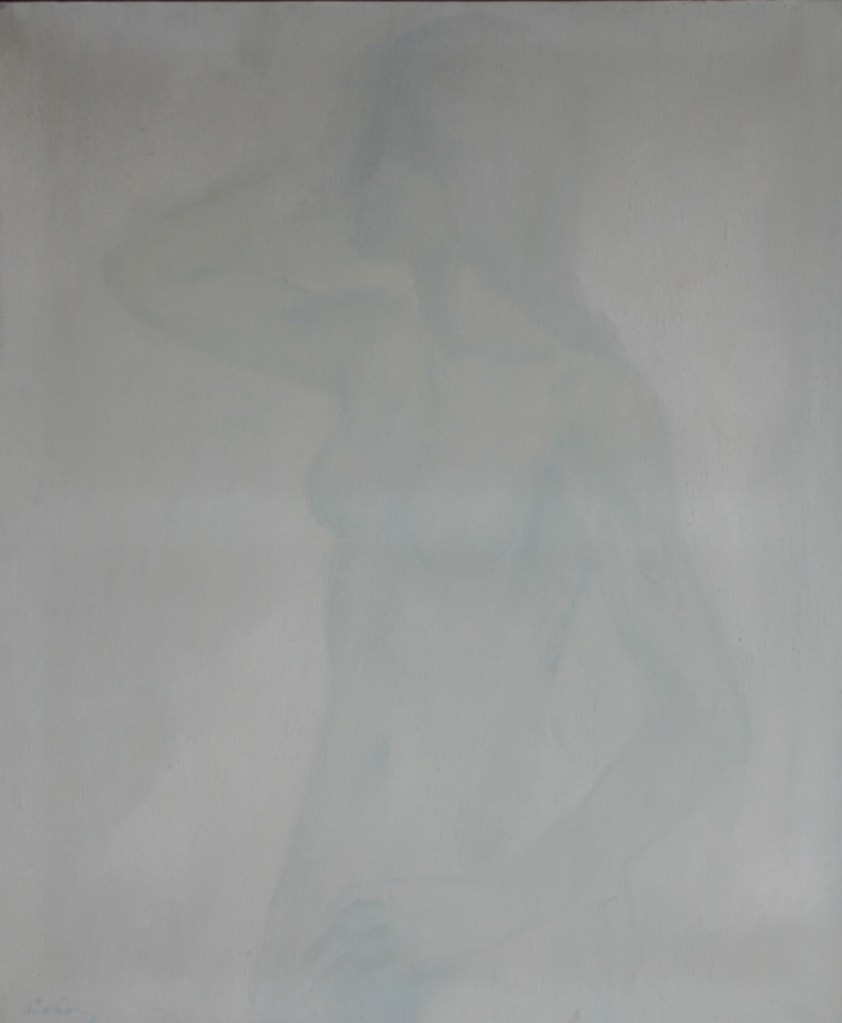
In the late 1960s, the substance becomes more liquid, clearer, Gilbert draws naked women titled « nus invisibles » (« invisible nudes »), then groups of men and women with grey, grey-blue, blue-green shades, always very poetic, of suggested eroticism, almost invisible.
Second Period
From the 1970s to the mid-1980s
The second era, “Noeuds et ligatures” (“pipes and knots”), begins in 1975. The painting is characterised by an evolution towards less immediately attainable topics than nudes or figurative style. Lisken leaves the human subject behind, tackled until then for a mechanical and rhythmic approach. He lives and paints to the sound of music, which he chooses among an eclectic repertoire: he develops an ideal huge disc collection composed of classical music, jazz and electroacoustic music.
Really moved by the creation of the Centre Pompidou by Renzo Piano and Richard Rogers in the heart of the Marais, he first paints series of pipes, tube windings, flexible ducts and key beams that fill the whole canvas and even seem to continue their cacophony beyond it. That is the word he uses himself for a 1975 painting. He lives to the rhythm of jazz and electronic music that he considers as a nice support to his painting. He shows his work in 1981 in Epinay-sur-Seine after having discovered surprising connexions and vibrations with Jean-Claude Eloy’s music : invited to visit Lisken’s studio, Eloy notices that the shapes seem to get moving when listening to his music. It is as if their compositions on the industrial city were expressed on the same waves.
At this time, the canvasses’ formats are more often vertical (115×80 cm).

Third Period
The years 1980-2000
The patterns become lighter and get more refined towards the early 1980s. Tensions and harmonies of shapes and colours are created. They will then be the essential elements explored by the painter. On a vast, colourful canvas, pipes intertwine in the middle. The hues are often blue, cut with a complementary colour. After the labyrinth of the pipes, Lisken becomes interested in the more intense tensions of the ”noeuds et ligatures” (“knots and ligatures”) ready to break. That becomes a recurrent theme until the early 1990s. ”At first studies of painted artworks’ structures, these links find their autonomy by forgetting their future role; and the energy of the stretched thread on its axis goes through the beautiful and mysterious unseen” (G. Lisken, April 20, 1982, exhibition catalogue ”Noeuds et ligatures”, rue Berryer, Paris 8e).
Between 1986 and 1991, Lisken works on canvas and on paper. He produces hundreds of oil drawings, painted and blown on geometrically-shaped stencils. The theme of knots is resumed and modified towards the theme of tearing, spirals appear, that will belong to the preferred shapes of the next era. His chromatic range is modified, influenced by Jean Bazaine, Alfred Manessier and Jean Le Moal.
With the black cuts that divide the canvas at the end of his life, he becomes involved — to a certain extent — in Lucio Fontana’s spatialist painting. Gilbert Lisken simultaneously becomes a recognised expert, in the entomological world, of a particularly colourful beetle species: buprestids. Their iridescent shades, the recurrent streaks on their elytra, the abundance of nature’s shapes have contributed to making the painter’s eye, his inspirations and aesthetic choices evolve. The fantasy of creation he observes with his binoculars during his insect identifications is reflected in his paintings.
This period is characterised by streaks or profiles that punctuate the canvas. The artist uses different techniques to apply his colours: blowing on stencil, brush and more rarely, sticking. The formats of these pictures are larger.
His work is largely dispersed in private collections but also in some French museums. You can check out his entomological work in the Confluences Museum in Lyon.

 Gilbert Lisken